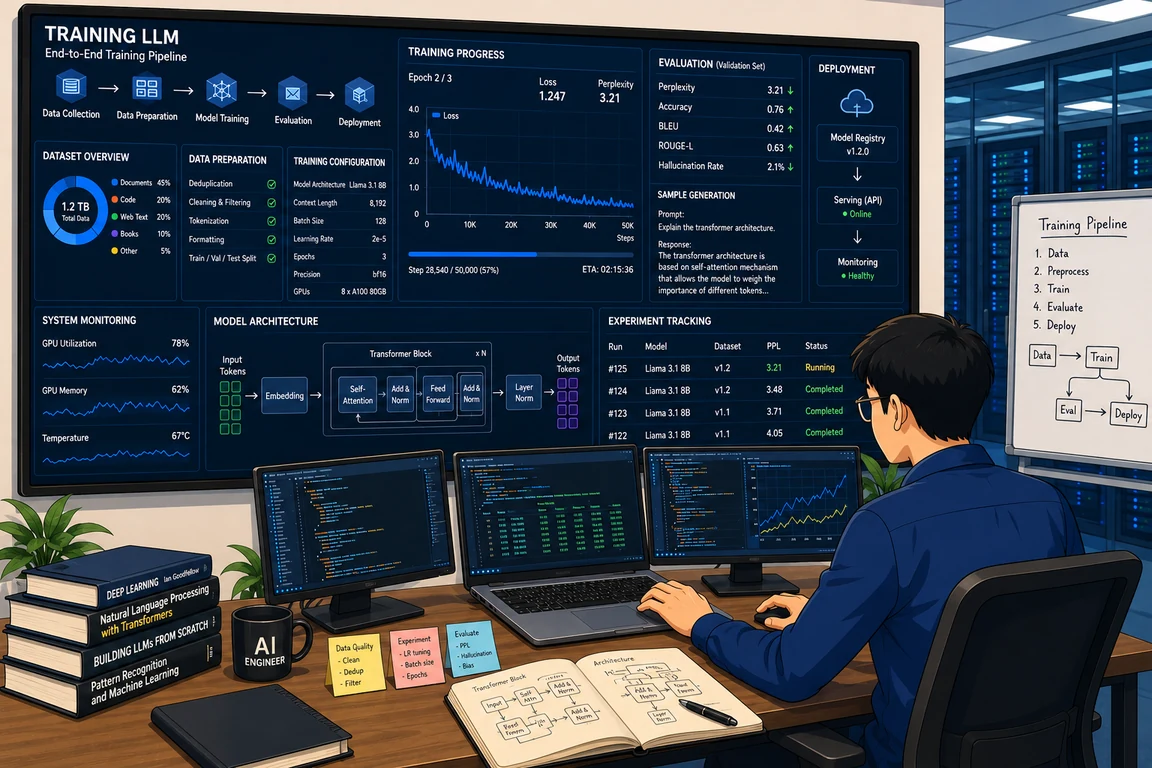
Training LLM workspace and monitoring dashboard for PT XIPTOR SOFTWARE SERVICE

Category 01

AI & Machine Learning

AI engineering scopes separated by model dependency, data control, evaluation burden, deployment architecture, and contractual rights allocation.

NATIVE LLM / DEDICATED FOUNDATION MODEL PROGRAM

Dedicated LLM engineering scope for controlled corpus preparation, tokenizer and checkpoint strategy, distributed training or continued pretraining, alignment, evaluation, inference serving, governance, and client-owned model handover.
  • Model specification defining target use cases, modality boundary, context budget, parameter class, throughput target, and acceptance metrics
  • Training-corpus rights register covering source authority, license exclusions, permitted use, retention, and data-transfer constraints
  • Dataset ingestion pipeline for structured, semi-structured, code, and document corpora with immutable lineage records
  • Corpus quality pipeline for exact and fuzzy deduplication, language filtering, toxicity screening, PII redaction, and contamination review
  • Domain mixture design with sampling ratios, curriculum policy, benchmark holdouts, and replay strategy for continual adaptation
  • Tokenizer assessment and vocabulary strategy for domain terminology, multilingual coverage, code tokens, and compression efficiency
  • Architecture and checkpoint strategy covering base initialization, continued pretraining, supervised fine-tuning, and alignment stages
  • Distributed GPU training plan with data, tensor, pipeline, or sequence parallelism selected against memory and compute constraints
  • Mixed-precision, activation-checkpointing, gradient-accumulation, and optimizer-state planning for stable large-run execution
  • Resumable checkpoint management with artifact hashing, storage policy, disaster recovery, and rollback-compatible versioning
  • Experiment tracking for hyperparameters, data snapshots, code revisions, hardware profile, loss curves, and evaluation lineage
  • Instruction dataset design for task coverage, refusal behavior, tool-use boundary, formatting discipline, and escalation cases
  • Preference or alignment workflow where required, with reviewer protocol, label quality checks, and policy-grounded comparison data
  • Domain benchmark suite for reasoning, extraction, summarization, retrieval dependence, code behavior, and long-context failure modes
  • Safety and abuse evaluation for harmful content, privacy leakage, prompt-injection susceptibility, memorization, and policy bypass
  • Release gate comparing candidate checkpoints against baseline models, regressions, cost envelope, and task-specific thresholds
  • Model card, system card, dataset documentation, evaluation report, and known-limitations register for each release candidate
  • Inference optimization path for quantization assessment, kernel compatibility, KV-cache behavior, batching, and latency profiling
  • Serving architecture with vLLM, TensorRT-LLM, Triton, or equivalent stack selected from model format and SLA constraints
  • Capacity model for tokens per second, time-to-first-token, tail latency, concurrency, context length, and GPU memory pressure
  • Access-control and secret-management design for model endpoints, artifact stores, training jobs, and administrative actions
  • Telemetry for prompts, completions, safety events, model versions, infrastructure utilization, and quality drift within policy limits
  • Incident and rollback procedure for model regressions, data leakage findings, serving failure, benchmark failure, and unsafe behavior
  • Handover package for agreed weights, checkpoints, configurations, data manifests, training recipes, evaluation evidence, and deployment runbooks
  • IP and dependency schedule separating client-owned artifacts from pre-existing methods, open-source software, cloud services, and third-party model licenses
USD 45.000.000 - 120.000.000 IDR 777.000.000.000 - 2.076.000.000.000 Request Scope

APPLIED AI / MODEL API INTEGRATION LAYER

Production application layer that consumes licensed model APIs through controlled orchestration, structured outputs, workflow rules, security boundaries, evaluation checks, and operational telemetry.
  • Workflow analysis defining model entry points, deterministic business rules, human checkpoints, and prohibited autonomous actions
  • Provider adapter layer for licensed model APIs with normalized request, response, error, retry, and timeout contracts
  • Model-routing policy by task, context size, latency target, cost ceiling, data boundary, and fallback availability
  • Prompt assembly service separating system instructions, user input, retrieved context, tool state, and policy constraints
  • Structured-output schemas for extraction, classification, drafting metadata, tool arguments, and downstream validation
  • Function or tool-calling orchestration with allowlists, typed arguments, permission checks, and side-effect isolation
  • Context minimization and redaction policy before external API submission for sensitive business fields
  • Tenant, role, session, and authorization boundary enforced outside the model output path
  • Secret isolation for provider keys, webhook credentials, service tokens, and environment-specific configuration
  • Rate limits, quotas, concurrency guards, idempotency controls, and retry discipline for model-backed endpoints
  • Streaming and non-streaming response handling with cancellation, timeout, partial-output, and user feedback states
  • Output validation, sanitization, moderation hooks, and policy rejection before database or UI side effects
  • Prompt-injection and untrusted-content controls for user input, attachments, URLs, retrieved text, and tool output
  • Curated lightweight knowledge context for FAQs, SOP snippets, product documents, scripts, or approved reference blocks
  • Provider-independent evaluation harness for prompt regressions, schema validity, refusal behavior, and workflow correctness
  • Golden test cases for high-frequency intents, edge cases, multilingual requests, malformed inputs, and escalation conditions
  • Cost telemetry for token use, provider spend, cache behavior, high-context requests, and failed retries
  • Quality telemetry for user feedback, failed intents, invalid structured outputs, fallback rate, and refusal rate
  • Audit logging for model version, prompt template version, tool invocation, reviewer action, and response disposition
  • Backend integration endpoints for internal systems, forms, ticket creation, document workflows, or notification services
  • Frontend interaction states for pending work, citations or references, review confirmation, errors, and escalation handoff
  • Availability controls with circuit breakers, provider failover behavior, graceful degradation, and non-AI fallback path
  • Security review for API boundary, data exposure, output handling, abuse controls, and dependency configuration
  • Deployment configuration for dev, staging, and production with observability, feature flags, rollback, and change control
  • Technical handover including architecture map, provider dependency register, prompt versions, tests, runbook, and disclosure boundary
USD 450.000 - 1.500.000 IDR 7.500.000.000 - 25.800.000.000 Request Scope

Foundation model development cost

What does it cost to develop a foundation model on current high-end GPU infrastructure under a production delivery standard?

Budgeting for a native model program extends beyond the number of accelerators assigned to training. The scope covers lawful corpus acquisition, data-quality controls, distributed training design, checkpoint recovery, evaluation gates, inference capacity, security controls, model governance, and a handover package that records ownership evidence and release accountability.

Large native-model reference band

USD 40.000.000 - 360.000.000 (IDR 652.000.000.000 - 5.900.000.000.000)

This budget band covers a large native foundation-model program on current high-end GPU infrastructure. Accelerator rental is only one cost component. Data pipelines, CPU preprocessing, high-throughput storage, interconnect capacity, distributed training engineering, failed-run allowance, safety and quality evaluation, serving architecture, MLOps, security review, rights allocation, and controlled delivery all affect the final estimate.

Larger research programs, multi-generation model portfolios, and permanent AI data-center ownership can exceed this band.

Frontier single-generation program

USD 300.000.000 - 3.000.000.000+ (IDR 4.900.000.000.000 - 49.000.000.000.000+) This band applies where a controlled native model delivery expands into a large training campaign with reserved accelerator supply, repeated experiment cycles, specialized evaluation operations, serving preparation, and budget allowance for failed or discarded runs before release acceptance.

Multi-generation model organization

USD 5.000.000.000 - 10.000.000.000+ (IDR 81.000.000.000.000 - 163.000.000.000.000+) Appropriate when the organization is funding a continuing model roadmap rather than one project: parallel research tracks, several training generations, reserved infrastructure, data governance operations, inference fleets, security and safety review, specialist hiring, platform maintenance, and product deployment across jurisdictions.

Cost drivers for a controlled build

Current rack-scale references include NVIDIA GB300 NVL72-class Blackwell Ultra systems. Training on that tier of infrastructure means designing for distributed compute, memory bandwidth, network saturation, job preemption, failure recovery, checkpoint integrity, and reproducible release evidence. Additional cost arises from domain reasoning requirements, traceable dataset lineage, post-training controls, red-team evaluation, rollback-ready serving, and contractual IP transfer without unresolved third-party rights.

Basis for a lower Xiptor entry scope

Xiptor scopes the training path against the acceptance target. Where the target permits staged training, continued pretraining, domain adaptation, retrieval architecture, or efficient adaptation, the compute plan can be limited to the model asset required by the client.

The delivery model also reduces idle capital burden. Xiptor coordinates engineers distributed across multiple countries and can combine approved cloud GPU capacity with vetted contributor GPU capacity for suitable workloads. Sensitive datasets, regulated workloads, residency constraints, and client security requirements still determine whether compute must remain in isolated cloud or dedicated controlled environments.

How the budget bands should be read

The first band, USD 40.000.000 - 360.000.000, describes the threshold where a native foundation-model program can become a material engineering and capital exercise before it is operated as a large research program. At this level, budget is consumed by lawful data sourcing, cleaning, deduplication, filtering, redaction, training corpus governance, high-speed storage, job scheduling, distributed checkpointing, evaluation harnesses, model registry controls, security review, inference serving, and the release evidence required for contractual handover.

The USD 300.000.000 - 3.000.000.000+ band is a different operating regime. It is no longer a simple increase in GPU hours. It normally assumes sustained access to very large accelerator pools, expensive failed experiments, multiple post-training and evaluation rounds, high-bandwidth networking, redundancy for storage and checkpoints, safety testing, expert data operations, and a serving plan capable of carrying the model after training. Release review at that scale requires reproducibility, recovery planning, measurement, and documented technical justification.

The USD 5.000.000.000 - 10.000.000.000+ band is better understood as an institutional capability budget. It covers a multi-generation program in which model development, infrastructure procurement, platform engineering, data licensing, evaluation research, security controls, human review, deployment reliability, and long-term operations are funded together. The commercial exposure is no longer tied to one training run. It is tied to maintaining a model organization that can repeat the work, improve the work, and defend the work under technical, contractual, and regulatory scrutiny.

For that reason, these figures are scoping references, not a public vendor quotation. A valid estimate must distinguish training from continued pretraining, adaptation, retrieval, inference, evaluation, and post-deployment monitoring. It must also state whether the client is buying a dedicated deliverable, reserved compute capacity, an isolated cloud environment, an on-premise cluster, or an ongoing research and production program.

Ten NVIDIA platform references for upper-tier cost simulation

Xiptor treats these as simulation references for the compute envelope, not as a public ranking by sticker price. The purpose is to compare rack-scale systems, scale-up platforms, supercomputer architectures, interconnect assumptions, memory profiles, and operational burden before a client is shown a model-development scope.

  1. NVIDIA DGX SuperPOD with DGX Vera Rubin NVL72 Systemssupercomputer-scale reference for a managed AI factory program.
  2. NVIDIA DGX Vera Rubin NVL72 Systemsrack-scale Rubin reference for high-end training and inference planning.
  3. NVIDIA DGX Rubin NVL8 Systemsturnkey Rubin system class for enterprise training and inference simulation.
  4. NVIDIA HGX Rubin NVL8scale-up platform reference when system builders control the surrounding data-center design.
  5. NVIDIA DGX GB300 SystemsBlackwell Ultra liquid-cooled DGX class for training, post-training, and demanding inference.
  6. NVIDIA GB300 NVL72rack-scale Blackwell Ultra reference for dense compute, memory, networking, and failure-domain planning.
  7. NVIDIA DGX B300 SystemsBlackwell Ultra DGX class for large generative-AI workloads.
  8. NVIDIA HGX B300high-end HGX platform reference for accelerated data-center integration.
  9. NVIDIA DGX GB200 SystemsGrace Blackwell DGX class for demanding foundation-model training and large-scale inference.
  10. NVIDIA DGX B200 SystemsBlackwell DGX class for training, tuning, and production inference comparison.

A lower commercial scope is not a claim that every model is trained from scratch on the same compute envelope as a hyperscale foundation-model program. The agreed architecture records the training path, compute boundary, data-handling controls, third-party license position, IP transfer scope, evaluation acceptance criteria, and production operating model.

AI risk briefing

AI and LLM deployment requires engineering control, legal clarity, and defined operational accountability

Fluent demonstration output is not a production acceptance criterion. When an AI system processes client communication, internal documents, personal data, code, financial review, legal material, operational instructions, or external tools, its behavior affects confidentiality, accuracy, service continuity, contractual representations, and stakeholder trust.

A weak implementation can increase operational risk while consuming budget. Outputs may be relied on without evidence, retrieval may expose information outside an authorized scope, model and dataset licenses may be misunderstood, evaluation may be absent, and automation may perform actions outside the approved execution boundary. The resulting exposure includes loss, dispute, remediation cost, and reputational damage.

Data and confidentiality failure

Training, retrieval, prompts, logs, feedback queues, and tool outputs can carry client information, personal data, trade secrets, credentials, or regulated records. Without data classification, access boundaries, retention policy, redaction, and processor/controller analysis, the implementation can create a disclosure path rather than a controlled knowledge system.

Invalid output and reliance risk

LLM fluency is not proof of correctness. Domain answers, citations, code generation, summaries, and recommendations require task-specific evaluation, ground-truth review, rejection criteria, escalation paths, and human accountability where the consequence of error is material.

Security and tool misuse

Prompt injection, sensitive-information disclosure, poisoned data, improper output handling, excessive agency, embedding weaknesses, and unbounded consumption are engineering risks. They cannot be cured by a prompt alone when the application grants model output access to files, databases, APIs, or customer-facing actions.

License, IP, and claim mismatch

Provider terms, open-source licenses, open-weight model terms, customer materials, generated project artifacts, and model checkpoints are not automatically the same legal object. Without a rights schedule and accurate product description, an organization can overstate ownership or deploy an asset under assumptions the contract and license chain do not support.

Production economics and reliability

GPU capacity, context length, throughput, latency, storage, vector indexes, observability, fallbacks, rollback, rate limits, and incident response affect operating cost and service reliability. A model that works in a small test can still fail acceptance under concurrency, long-context retrieval, load, or cost ceilings.

Business trust and liability surface

When an AI system leaks client material, fabricates a relied-on answer, mishandles personal data, or performs an unauthorized operation, the damage is not limited to a model metric. It can trigger customer complaints, contractual review, evidence reconstruction, security remediation, service suspension, and loss of confidence in the business itself.

Required discipline before scale

Production AI delivery requires a documented model boundary, data authority and retention rules, dependency and license review, evaluation protocol, security controls, monitoring evidence, release criteria, and a handover record identifying authorized operation, modification, and reliance for each artifact.

High-consequence deployment

The risk threshold is higher when AI is entrusted to security, finance, government, health, or critical operations

In these environments, an LLM is not merely a writing aid. It may influence incident handling, fraud review, public service communication, patient workflow, industrial continuity, or access to sensitive records. A defective model boundary, an untested retrieval layer, or unauthorized tool execution can therefore create harm that exceeds ordinary software inconvenience.

Cyber security teams

A security assistant that misclassifies evidence, invents indicators, leaks incident material, executes unsafe triage, or accepts injected instructions can corrupt the chain from detection to response. The resulting exposure may include delayed containment, loss of forensic integrity, disclosure of vulnerabilities, and false confidence during an active incident.

Banks and financial operations

Banking AI can touch customer data, fraud operations, service eligibility, complaints, risk review, and regulated digital processes. Without tested fairness, traceability, human oversight, model monitoring, and data-security controls, the system can amplify operational loss, unfair treatment, inaccurate client communication, regulatory findings, and erosion of depositor or customer trust.

Government and public services

Public-sector AI can affect official information, administrative records, eligibility workflows, citizen correspondence, and procurement accountability. If the model is inaccurate, opaque, or deployed without evidence of governance, the failure can become a public-law and institutional-trust problem: misinformation, unequal treatment, poor auditability, and impaired public service.

Health facilities

Health workflows may involve patient data, clinical context, scheduling urgency, device-adjacent information, and decisions that must remain accountable to qualified personnel. A hallucinated recommendation, unvalidated summary, privacy failure, or performance drift across patient populations can affect patient safety, duty of care, documentation integrity, and confidence in the facility.

Critical infrastructure operators

Energy, telecom, transport, water, industrial, and other critical services require availability, resilience, and controlled operational authority. AI that mishandles OT or IT context, exposes operational data, suppresses a real alert, escalates a false one, or triggers an unapproved action can contribute to service disruption, safety risk, cascading dependency failure, and incident accountability.

High-consequence rule

The more a system can influence rights, money, security, health, public authority, or physical continuity, the more the design requires evidence-based constraints: authorized data, threat modeling, evaluation sets, role separation, human decision checkpoints, logs, rollback, incident handling, and a written allocation of responsibility.

User
App / Model Workflow Frontend + Backend
Provider AI
01

Applied AI Integration

Application layer that binds a selected model endpoint to authenticated users, structured context, tool calls, business rules, review states, and audit telemetry.

Technical position: Model capability is consumed through a provider API or externally licensed endpoint; the delivered system is the application and workflow layer around that dependency.

Rights position: Describe the scope as provider-integrated AI unless a separate model-license or model-development scope is contracted.

Difficulty 1 / 5
User
App + RAG Knowledge Base
Custom LLM
02

Custom LLM

Domain system assembled from governed retrieval, prompt and tool orchestration, evaluation assets, and, where justified by data and acceptance criteria, adapter or fine-tuning work.

Technical position: The custom layer may include ingestion, chunking, embeddings, reranking, retrieval policy, citations, response controls, reviewer feedback, and deployment integration.

Rights position: Customer-specific artifacts and third-party model components should be separated in the scope, license schedule, and handover documents.

Difficulty 3 / 5
Data
Training Cluster Governance + Serving
Native LLM
03

Native LLM

Dedicated model program covering dataset governance, model configuration, training or continued adaptation runs, checkpoints, evaluation gates, serving, release controls, and operations.

Technical position: Native scope is defined by controlled model artifacts and operations, not by a UI label or an API wrapper.

Rights position: The contract should identify datasets and permitted use, weights and checkpoints to be delivered, source and configuration artifacts, third-party dependencies, deployment and modification rights, acceptance tests, and post-handover responsibilities.

Difficulty 5 / 5

AI delivery controls

Engineering controls for an AI build

The model, data, software, security controls, and rights schedule are treated as separate engineering deliverables before release and handover.

Scope and model boundary

Architecture states whether the system is provider-integrated, retrieval-augmented, adapted from licensed weights, or trained under a dedicated model program. That boundary controls claims, acceptance criteria, infrastructure commitments, and transfer documents.

Data and rights traceability

Data intake is tied to source authority, permitted use, retention, redaction, lineage, and confidentiality handling. Base-model licenses, third-party services, customer materials, and newly created project artifacts are documented separately.

Release evidence and operations

Delivery includes evaluation sets, quality and safety checks, latency and capacity observations, access controls, audit telemetry, rollback path, and handover records so production behavior can be reviewed after deployment.

Architecture selection

AI architecture aligned with workload, rights, and operating constraints

Model and system architecture are selected from the workload evidence: task definition, data authority, required evaluation signal, latency and throughput target, security boundary, deployment environment, and ownership or handover requirement.

System design boundary

A provider model, retrieval system, adapter fine-tuning, domain model, or native model program is chosen only after the dependency boundary is clear. This keeps application logic, datasets, evaluation assets, model artifacts, and production controls separable when the scope changes.

Cloud GPU execution at scale

For accelerator-heavy work, Xiptor uses cloud GPU capacity for dataset processing, embedding and reranking jobs, fine-tuning, training or continued adaptation runs, checkpoint evaluation, inference profiling, and load validation. Multi-GPU or distributed jobs are used when the model size, memory demand, experiment matrix, or serving target requires that scale.

Native AI ownership position

A purchased Native AI scope is prepared as a buyer-owned dedicated model deliverable. The handover identifies the project-specific weights, checkpoints, configurations, documentation, deployment materials, and acceptance records transferred to the buyer so the buyer can control use, modification, deployment, commercialization, and IP filing for the transferred deliverables.

For a Native AI, Native LLM, or dedicated model scope purchased as a client-owned build, the project agreement provides for assignment and delivery of the agreed project deliverables to the buyer within the documented transfer scope. The transfer schedule identifies the deliverable model artifacts, weights, checkpoints, configurations, documentation, deployment materials, and rights needed for the buyer to use, modify, deploy, commercialize, and register the deliverables in its own name under the applicable intellectual-property regime.

Intellectual property controls

Intellectual property allocation is recorded by deliverable, dependency, and permitted use

The handover record separates assignment of project deliverables from licensing, source-material authority, and third-party dependency obligations. The agreement and asset schedule provide the review basis for registration, commercialization, deployment, and subsequent due diligence.

Assignment of project deliverables

The deliverable schedule identifies the native model outputs transferred to the buyer, including weights, checkpoints, configuration files, training or adaptation recipes, evaluation evidence, deployment materials, documentation, and other agreed project artifacts.

Source materials and dataset authority

The data register records provenance and permitted use for customer documents, licensed corpora, public datasets, annotations, synthetic datasets, and retained training manifests across training, evaluation, deployment, and future modification.

Third-party and open-source terms

Libraries, frameworks, hosted services, base models, externally licensed weights, and cloud products remain subject to applicable license and service terms. The dependency schedule separates those components from buyer-owned project deliverables.

Registration and evidence package

Registration or recordation is supported by the chain of title, written transfer language, artifact inventory, acceptance record, authorship or contributor record where applicable, and technical evidence of the delivered scope.

OpenAIOpenAI Claude AnthropicClaude DeepSeekDeepSeek Google GeminiGemini Mistral AIMistral CohereCohere Meta LlamaLlama GroqGroq Perplexity AIPerplexity Hugging FaceHugging Face ReplicateReplicate Azure OpenAIAzure AI
AI Cyber Lady Justice and legal scale iconAI Legal AI Banking AI Coding AI Health AI Retail AI Data AI Support
Amazon S3S3 DVCDVC Apache SparkSpark Hugging Face DatasetsHF Data SentencePieceSPiece tiktokentiktoken PyTorchPyTorch Hugging Face TransformersHF Trans DeepSpeedDSpeed Megatron-LMMegatron FlashAttentionFlashAttn Weights and BiasesW&B MLflowMLflow EleutherAI Evaluation HarnessEval HELMHELM Label StudioLabel vLLMvLLM FastAPIFastAPI TensorRTTensorRT KubernetesK8s Apache AirflowAirflow FAISSFAISS WeaviateWeav. Perspective APIPersp. ONNX RuntimeONNX